

SMLIGHT SLWF-03
SMLight · A1-SLWF-03
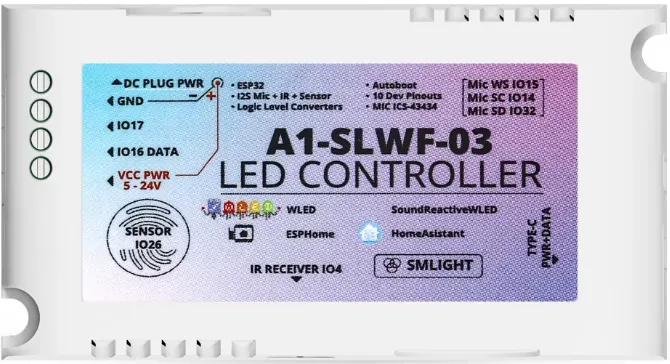
The SMLIGHT SLWF-03 is a compact controller for addressable LED strips based on ESP32, designed for WLED projects, ambient lighting, sound-reactive effects, LED matrices, desk lighting, TV backlighting, display cabinets, furniture, or custom installations. It comes with WLED Sound Reactive preinstalled, so it can be used as a WLED controller as soon as you plug it in, without having to compile or flash firmware at first. Unlike basic LED controllers, it integrates an ICS-43434 digital I2S microphone, making it possible to create music- or sound-reactive effects directly from compatible WLED. For connectivity, it uses 2.4GHz WiFi 802.11 b/g/n and can be integrated with Home Assistant via the native WLED integration, MQTT, or alternative firmware such as ESPHome. It is also compatible with ESPHome BT Proxy, Tasmota, and custom ESP32 firmware, making it a flexible board for both smart home users and maker projects. On the physical control side, it includes a 38kHz IR receiver for infrared remotes, a capacitive touch button, and an integrated USB-UART programmer with autoflash. This makes it possible to update or restore firmware from the web flasher without manually pressing BOOT buttons, greatly simplifying maintenance compared with generic ESP32 boards. The LED output provides 2 ready-to-use channels through screw terminals and up to 6 additional channels via the lower DIY pinout. In total, it can reach 8 LED channels, with support for common chipsets such as WS2812B, WS2811, WS2813, WS2815, SK6812, APA102, LPD8806, and WS2801. SMLIGHT indicates an approximate capacity of up to 1500-2000 LEDs at 30 FPS, although real-world performance will depend on the chipset, number of channels, effects, power supply, and WLED or ESPHome configuration. For power, it can run from 5V USB-C, from a DC barrel jack, or through the input terminal block with 5V, 12V, or 24V. The board includes reverse-polarity and overvoltage protection, but the LED strip power must be sized correctly according to the actual LED consumption. For large installations, the power supply and power injection are just as important as the controller. It is not a Zigbee, Thread, Matter, Ethernet, or PoE device. It is a WiFi/ESP32 controller focused on WLED and open firmware. For Home Assistant, its most direct use is as an automatically discovered WLED light, although it can also be turned into a microphone for Voice Assistant or a Bluetooth BLE proxy if the proper ESPHome firmware is flashed.
✓ Pros
- WLED Sound Reactive preinstalled
- Based on ESP32
- Easy Home Assistant integration via WLED
- Compatible with MQTT
- Compatible with ESPHome
- Can work as an ESPHome BT Proxy
- Can be used as a microphone for Home Assistant Voice Assistant with ESPHome
- Compatible with Tasmota and custom firmware
- Integrated ICS-43434 digital I2S microphone
- Integrated 38kHz IR receiver
- Integrated capacitive touch button
- 2 LED channels via ready-to-use terminal block
- 6 additional LED channels via DIY pinout
- Up to 8 LED channels in total
- Supports addressable LED strips of 5V, 12V and 24V
- Compatible with WS2812B, WS2811, WS2813, WS2815, SK6812, APA102, LPD8806 and WS2801
- Up to approximately 1500-2000 LEDs at 30 FPS according to SMLIGHT
- Flexible power via USB-C, DC jack or terminal block
- Reverse-polarity protection
- Overvoltage protection
- Integrated USB-UART programmer
- Autoflash without pressing the BOOT button
- Very compact 57 x 30 x 23 mm format
- Includes mounting accessories according to the manual
✗ Cons
- Not Matter, Zigbee or Thread
- No Ethernet or PoE
- 2.4GHz WiFi only
- Bluetooth requires compatible firmware such as ESPHome BT Proxy; it is not a core out-of-the-box WLED feature
- Requires knowledge of WLED, ESPHome, or LED wiring to get the most out of it
- The LED strip power supply must be sized separately
- Does not replace an LED power supply
- For many LEDs, it may require additional power injection
- DIY channels require extra wiring and technical knowledge
- GPIO12 is a strapping pin and pull-high at startup should be avoided
- It is not a closed lighting product ready for any user
- Not suitable for outdoor use without a protective enclosure
- Does not control traditional analog RGB/CCT LED strips unless firmware and external hardware allow it
- Real LED capacity depends on the chipset, FPS, effects, power supply, and configuration
Compatibility
Specifications
| Model | A1-SLWF-03 |
| Type | controller for addressable LED strips |
| Platform | ESP32 |
| Factory firmware | WLED Sound Reactive / WLED-SR |
| Compatible firmware | WLED-SR, ESPHome, ESPHome BT Proxy, Tasmota and custom ESP32 firmware |
| Main connectivity | 2.4GHz WiFi IEEE 802.11 b/g/n |
| Home Assistant | compatible via WLED, ESPHome or BT Proxy depending on firmware |
| MQTT | compatible via WLED/firmware |
| Bluetooth | possible as a Bluetooth LE Proxy with ESPHome BTProxy firmware |
| Microphone | integrated digital I2S ICS-43434 |
| IR receiver | integrated 38kHz |
| Button | integrated capacitive touch |
| Power inputs | USB-C 5V, DC jack 5/12/24V and 5/12/24V terminal block |
| USB-C power range | 4.75-5.25V |
| DC/terminal block power range | 4.75-25.2V |
| Idle current | 75-110mA with WiFi connected and LEDs off |
| Microphone + WiFi current | 110-160mA |
| Protection | reverse polarity and overvoltage |
| LED channels via terminal block | 2 |
| DIY LED channels | 6 via lower header |
| Total LED channels | up to 8 |
| Maximum current per terminal-block channel | 5A momentary at 25°C according to datasheet |
| Logic level before the level shifter | 3.1-3.5V |
| Indicated LED length | 1500 typical, up to 2000 LEDs at target 30 FPS |
| LED rate | 30-60 FPS typical depending on chain length |
| Supported LED chipsets | WS2812B, WS2811, WS2813, WS2815, SK6812, APA102, LPD8806 and WS2801 |
| Strip support | 5V, 12V and 24V addressable |
| DIY pinout | GPIO2 LED CH3, GPIO4 LED CH4, GPIO5 LED CH5, GPIO12 LED CH6, GPIO13 LED CH7, GPIO14 LED CH8, GND and 3V3 |
| 3V3 output for user | 200mA max |
| GPIO12 | strapping pin, avoid pull-high at startup |
| Dimensions | 57 x 30 x 23 mm |
| Approximate weight | 18 g |
| Mounting hole spacing | 51 x 24 mm |
| Screws | M3 |
| Operating temperature | +5°C to +35°C |
| Recommended humidity | less than 60% RH non-condensing |
| Storage temperature | -20°C to +60°C in a dry environment |
| Box contents according to the manual | A1-SLWF-03 controller, microUSB to USB-C adapter, 2 stickers, 2 screws, screw terminal screwdriver, screw driver, screw helper accessory and QR/manual |
| Power supply | USB-C 5V, jack DC 5/12/24V o bornera 5/12/24V |
| Neutral wire required | No |
Related content
Watch on YouTube
Cómo Hacer un Ambilight Casero y Barato: Guía con WLED, Hyperion y Home Assistant
¿Te gustaría tener una experiencia de cine inmersiva sin gastar los cientos de euros que cuestan los sistemas comerciales? Hoy vamos a montar un Ambilight DIY (Hazlo tú mismo) profesional, utilizando componentes económicos y software de código abierto. Con este sistema, las luces de detrás de tu monitor o TV reaccionarán en tiempo real a los colores de la pantalla. Además, lo integraremos con Home Assistant para que se encienda y apague solo cuando empieces a ver una película o a jugar.
Read review