

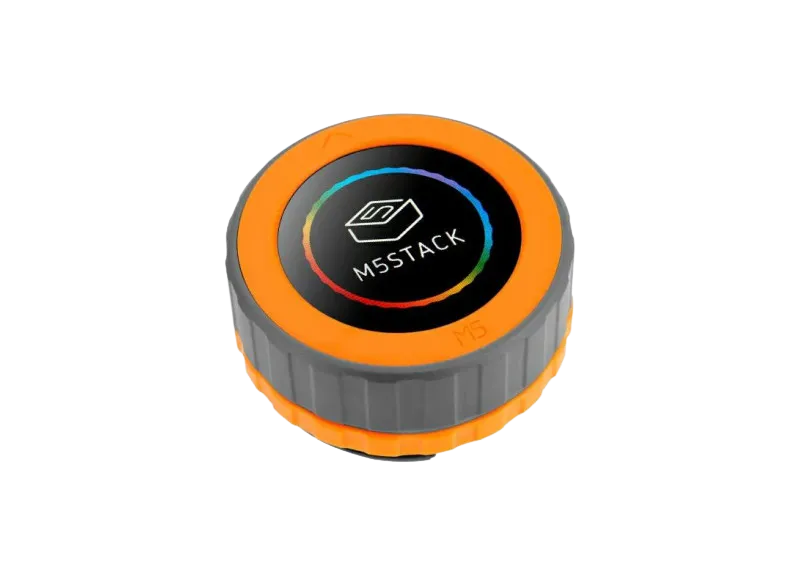
M5Stack Dial v1.1
M5STACK · K130-V11
The M5Stack Dial v1.1 is a compact ESP32-S3-based rotary controller designed for building custom physical interfaces for smart homes, IoT, light industrial control, automation, control panels and maker projects. It combines a 1.28-inch round touchscreen with a 240 × 240-pixel resolution, a precision rotary encoder, a 13.56 MHz RFID/NFC reader, an integrated buzzer and the Wi-Fi connectivity provided by the ESP32-S3. Its main appeal for smart home users is the ability to create a local physical controller for Home Assistant. With the right firmware, it can control lights, scenes, climate systems, media volume, blinds, home modes or any entity exposed by Home Assistant. The combination of rotation, pressing and touch control provides a much more convenient experience than a basic button or switch. It is not a Matter, Zigbee or Thread device out of the box. Nor is it a ready-to-use Home Assistant accessory straight from the package. It is a programmable development board and controller that requires firmware to be installed, for example through ESPHome, Arduino IDE, UIFlow2, ESP-IDF or PlatformIO. This makes it particularly interesting for advanced users who want to customise the interface, graphics, entities and control logic. Version v1.1 uses the M5StampS3A as its main controller while retaining the compact M5Dial format. It integrates a 1.28-inch circular GC9A01 TFT display, an FT3267 touch controller, a 16-position rotary encoder with 64 pulses per revolution, an 80 dB buzzer and a WS1850S RFID reader compatible with ISO/IEC 14443 Type A and Type B. For power, it can run from 5V USB-C, a battery connected to the 1.25 mm 2-pin connector, or a wide 6–36V DC input. This makes it suitable both for desktop use and for integration into a permanent installation, provided the correct wiring and power supply are used. For Home Assistant, the most common approach is to use ESPHome or custom firmware. Once configured, it can communicate over Wi-Fi and work as a control panel, scene dial, lighting controller, visual thermostat, media selector or room status interface. The exact integration depends entirely on the installed firmware and the entities exposed by Home Assistant.
✓ Pros
- ESP32-S3 based
- 1.28-inch round touchscreen
- 240 × 240-pixel resolution
- Integrated rotary encoder
- 13.56 MHz RFID/NFC reader
- Integrated 80 dB buzzer
- Compatible with ESPHome projects
- Highly suitable as a physical controller for Home Assistant
- Can control lights, scenes, climate, media or blinds with custom firmware
- Supports UIFlow2, Arduino IDE, ESP-IDF and PlatformIO
- Wide 6–36V DC power input
- Can also be powered through USB-C
- Battery connector
- Compact 51 × 51 × 32.3 mm format
- Ideal for maker projects, IoT and custom control panels
✗ Cons
- Not supplied as a ready-to-use commercial Home Assistant device
- Requires firmware installation and configuration
- Not a Matter, Zigbee or Thread device
- No Ethernet or PoE
- No 5 GHz Wi-Fi
- OpenELAB does not specify usable Bluetooth support on the product page
- Home Assistant integration depends on the firmware used
- The screen is small for complex dashboards
- Does not include an advanced wall enclosure or power supply for a permanent installation
- May require knowledge of ESPHome, YAML, Arduino or ESP-IDF
- Not a factory-certified thermostat or smart home controller
- Not suitable for outdoor use without a protective enclosure
Compatibility
Specifications
| Product | M5Stack Dial v1.1 |
| SKU | K130-V11 |
| Type | smart rotary controller / IoT development board |
| SoC | ESP32-S3 |
| Main controller specified by M5Stack | M5StampS3A |
| CPU | Xtensa LX7 |
| Flash | 8 MB |
| Wireless connectivity | Wi-Fi integrated into the ESP32-S3 |
| Display | round GC9A01 TFT |
| Display size | 1.28 inches |
| Resolution | 240 × 240 pixels |
| Touchscreen | yes |
| Touch controller | FT3267 |
| Rotary encoder | 16 positions, 64 pulses per revolution |
| RFID/NFC | WS1850S, 13.56 MHz |
| RFID compatibility | ISO/IEC 14443 Type A and Type B |
| Buzzer | 80 dB |
| USB | USB-C, OTG/CDC support according to the specification |
| Wide power input | 6–36V DC |
| Battery connector | 1.25 mm 2-pin |
| Idle current over USB | 5V DC at 6.84 mA |
| Idle current on battery only | 4V DC at 6 μA |
| Operating current over USB | 5V DC at 88.19 mA |
| Operating current on battery only | 4V DC at 100 mA |
| Operating temperature | 0–40 °C |
| Dimensions | 51.0 × 51.0 × 32.3 mm |
| Weight | 46.2 g |
| Development environments | UIFlow2, Arduino IDE, ESP-IDF and PlatformIO |
| Recommended use | smart home control, IoT, physical interfaces, light industrial control, RFID access, automation and educational projects |
| Home Assistant | compatible through custom firmware or ESPHome |
| MQTT | possible through custom firmware |
| Package contents | M5Stack Dial v1.1 according to the OpenELAB listing |
| Power supply | USB-C 5V, batería 1.25mm-2P o entrada DC 6-36V |
| Neutral wire required | No |
Related content
Watch on YouTube
M5Stack Dial with Home Assistant: Build an ESPHome Smart Home Controller
Learn how to turn the M5Stack Dial into a practical physical controller for Home Assistant using ESPHome. This guide covers hardware testing, ready-made open-source firmware, customisation, wall or desk installation, and control of lights, climate, blinds and media players—without having to build everything from scratch.
Read review