mmWave Presence Sensors: 24GHz or 5.8GHz? Complete Guide (Home Assistant + Zigbee2MQTT)
mmWave presence sensors have completely changed home automation. If you're coming from traditional PIR sensors, this is a whole different game: here you're not just detecting motion... you're detecting whether someone is breathing in a room. But now there's a new question when buying on AliExpress: should you choose a 24GHz sensor or a 5.8GHz one? In this article, you'll find a clear, no-nonsense guide: the real differences, when to choose each one, and how to set them up correctly in Home Assistant.
On YouTube I share more tutorials, hands-on tests and real smart home setups. Subscribe on YouTube
Related video on YouTube
VideoWhat actually changes between 24GHz and 5.8GHz
The key is how radio waves behave.
Basic rule:
The higher the frequency → the faster it reacts, but the shorter the range and the weaker the penetration.
That translates directly into how these sensors perform at home.
⚖️ Quick comparison
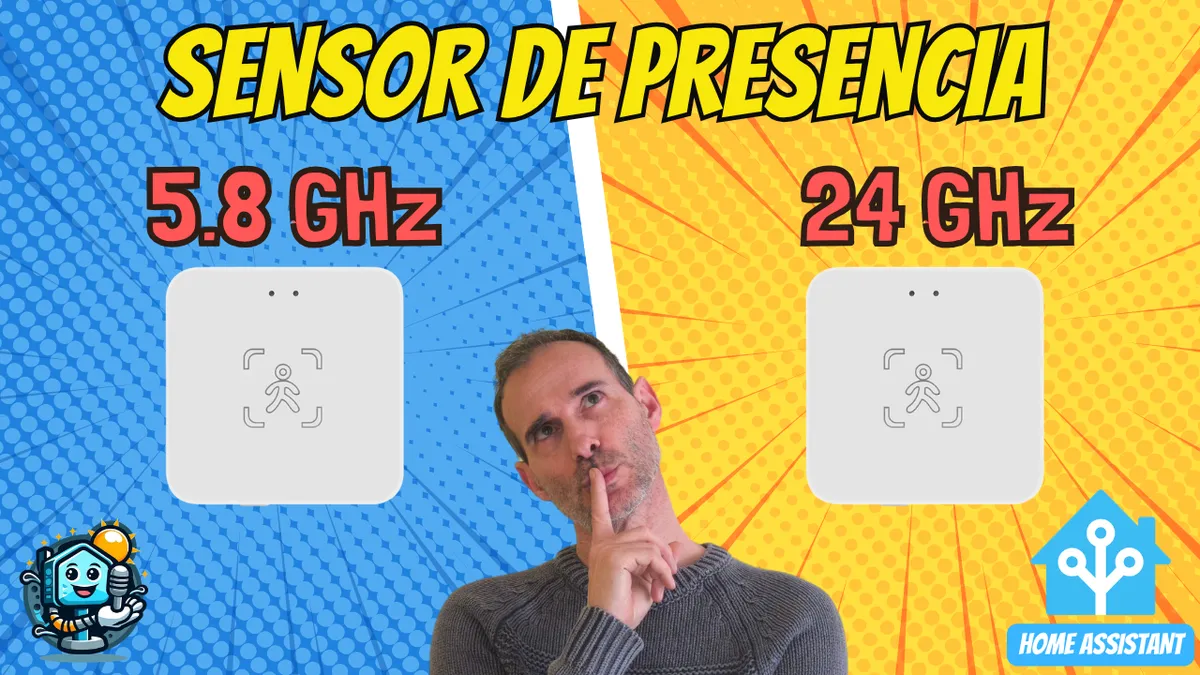
To make things easier, here's a quick look at the differences between both sensor types:
| Feature | 24 GHz | 5.8 GHz |
|---|---|---|
| Range | ~6 meters | ~10 meters |
| Wall penetration | Low (better for avoiding external false positives) | High (better for complex rooms) |
| Accuracy in a room | Very high | Medium |
| False positives outside the room | Very few | More likely |
| Ideal for... | Bathrooms, small offices, fast passage areas. | Large living rooms, rooms with corners. |
24GHz mmWave sensor: fast and accurate
This is the one that's gaining ground right now.
When to use it
- Bathrooms
- Small home offices
- Hallways
- Rooms where you want absolute accuracy
Real advantages
- Detects presence faster
- Prevents detection of people in adjacent rooms
- Better for critical automations (lights, alarms, etc.)
Typical problem it solves
If you have a sensor that turns on the bathroom light when someone walks by in the hallway...
👉 the 24GHz one is the solution.
5.8GHz mmWave sensor: more range and wider coverage
It's the “classic” option that's been used up to now.
When to use it
- Large living rooms
- Rooms with corners or nooks
- Open areas
Advantages
- Greater range (up to ~10m)
- Better behavior in complex spaces
- Less affected by obstacles
Weak point
- Can detect through walls
- More likely to produce false positives
Advanced setup (key to making them work well)
This is where most people go wrong.
These sensors are not “plug & play”. They need fine-tuning.
States you can configure
- Large motion → someone entering or walking
- Small motion → moving hands or head
- Static presence (stillness) → someone completely still
⚠️ Critical setting: the timeout
This is VERY important.
Even if they detect presence perfectly, they can still have millisecond micro-drops.
Recommended setting
- Timeout: 5 to 10 seconds
This prevents:
- Lights turning off while you're still sitting there
- Erratic automations
Home Assistant integration (Zigbee2MQTT)
They work perfectly with Zigbee2MQTT.
Most important entities
presence→ presence detectedilluminance_lux→ ambient lightradar_sensitivity→ sensitivitydetection_distance→ maximum distance
Real configuration example
After pairing:
- You enable “permit join” in Zigbee2MQTT
- You hold down the sensor button
- It appears automatically
- You rename it (important so you don't get lost later)
Example:
- Name:
sensor_presencia_salon - Entity:
binary_sensor.presencia_salon_occupancy
Recommended settings (starting point)
- Sensitivity → low/medium
- Distance → set for the room (don't use the maximum)
- False negative filter → enabled if available
⚡ PRO tip (very important)
Don't start with high values right away.
👉 Start conservatively and increase little by little
Otherwise:
- It will detect movement outside the room
- You'll get constant false presence events
And what about battery-powered sensors?
There are new versions that work without a cable.
Clear advantage:
- You can place them wherever you want
Disadvantage:
- Less power and range
- Less accurate than wired models
🧠 Final takeaway
- You want accuracy and fewer mistakes → 24GHz
- You want to cover a large space → 5.8GHz
If you're unsure:
👉 In 80% of home cases → 24GHz is the better choice today
If you set sensitivity + distance + timeout correctly...
👉 you'll get practically perfect automations.
Where to buy
If you are interested in any of the options mentioned, here are the available links:
Presence sensor
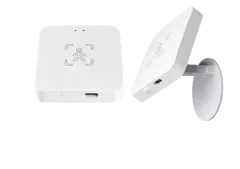
- Tuya mmWave Human Presence Sensor Zigbee/WiFi — Reviewed in the video: Aliexpress
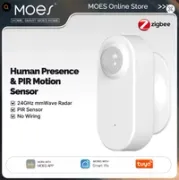
- MOES ZSS-HP05-A-MS — Equivalent alternative (Sin cables, a pilas): Official store · Amazon · AliExpress
Zigbee / Matter / Thread coordinator
- Tuya Smart Life Zigbee Hub WiFi + Bluetooth Multi-Mode: Aliexpress
Related video

Reviewed device